Flat
Break boxes down
EPA lists uncompacted corrugated and chipboard at about 75 pounds a cubic yard, against 106 for flattened corrugated.2 Flattening fits more into every pickup and stops boxes bridging in the container.
Corrugated boxes are the largest single product category in U.S. municipal solid waste, and the most recycled. EPA counts 33.3 million tons generated in 2018 and a 96.5 percent recycling rate.1 For a store or a warehouse, the work is keeping your own boxes in that stream: flattened, dry and free of trash.
Why it is its own stream
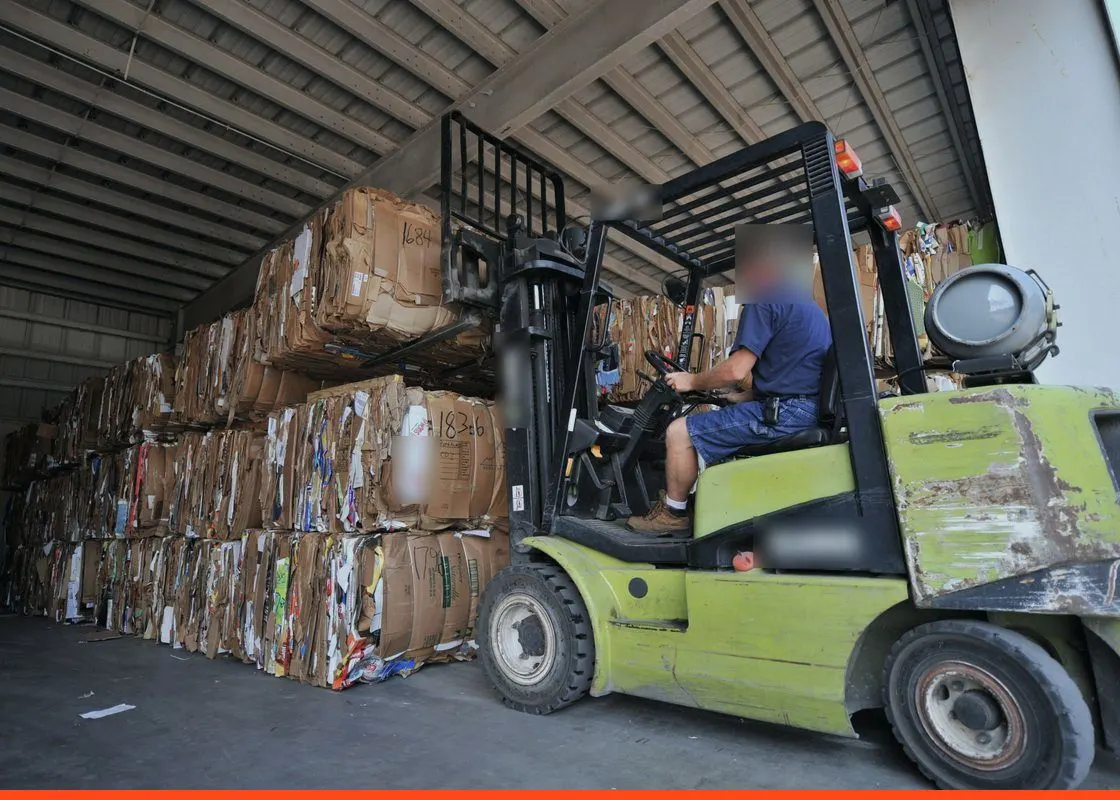
EPA puts flattened corrugated at about 106 pounds a cubic yard.2 Thrown in the trash, boxes take up space you pay to haul. Kept apart, they go to a mill as a material, which is why a building with steady deliveries treats cardboard as its own stream.
One bale, counted in flattened boxes
7.5 to 9.4 cu ydof flattened boxes
One bale800 to 1,000 lb, about 1.85 cu yd
A bale packs the same cardboard into a fraction of the space, ready for a recycler to pick up off the dock. Flattened boxes in a dedicated container skip the machine and still keep cardboard out of the trash.
Not recycled, cardboard mostly ends up in a landfill: EPA counts 940,000 tons of corrugated boxes landfilled in 2018.1 Those are national figures, not a site's diversion rate and not a price for a bale.
Which setup
The choice turns on how much cardboard you make, how much floor you have and who takes the output.
Flattened boxes only, emptied on a schedule or when full. No machine to run and no floor space inside the building.
Vertical in a back room, horizontal where boxes never stop. Worth it when you fill a bale every few weeks. Our provider network supplies balers to rent or lease.
Cardboard can go in a trash compactor, but it goes out as trash. A compactor full of clean cardboard is a missed recycling load.
The baler vs compactor guide compares the machines on footprint, power and output, and compactors and balers covers renting one and the backup when it is down.
How much
Estimate the flattened cubic yards you make in a week. Weight comes from EPA's flattened figure;2 bales use the 800 to 1,000 pound bale from our baler guide.
| Flattened boxes a week | About | Bales | Usual fit |
|---|---|---|---|
| 2 cu yd | 212 lb | One every 4 to 5 weeks | A cardboard container |
| 5 cu yd | 530 lb | About one every 2 weeks | Either; compare space and pickups |
| 10 cu yd | 1,060 lb | 1.1 to 1.3 a week | A vertical baler |
| 20 cu yd | 2,120 lb | 2.1 to 2.7 a week | A baler with a regular bale pickup |
Planning figures only. Your recycler's scale decides, and boxes packed loosely or left wet weigh differently. Run your own volume through the sizing tool in the baler vs compactor guide, which also sizes the trash compactor.
Flat, dry, clean
A bale with trash in it is not a mill bale. Most of the work happens at the point where boxes are opened.
Flat
EPA lists uncompacted corrugated and chipboard at about 75 pounds a cubic yard, against 106 for flattened corrugated.2 Flattening fits more into every pickup and stops boxes bridging in the container.
Dry
Rain adds weight the scale counts and soaks the fiber. Close container lids, store bales indoors or covered, and ask your recycler how it treats wet loads.
Clean
Trash, food and liquids make a load harder to sell or get it refused. A clear sign and a separate trash can beside the container do most of the work.
Ask first
Waxed produce boxes, boxes with plastic liners and greasy food boxes are where recyclers differ. Your recycler sets the list, so ask before they go in.
Setting it up
Count flattened cubic yards or bales for two or three weeks, including a delivery-heavy one.
A container for lower volume, a baler when you fill a bale every few weeks. Check floor space and power before a baler.
Receiving, the stockroom or the dock. A long walk to the container is how cardboard ends up in the trash.
Cardboard only, flattened. Only trained adults run a baler; see the safety rules.
Containers emptied before they overflow, bales picked up before they crowd the floor.
Ask for tons by stream from hauler and facility tickets if you report diversion or ESG numbers.
Keep it out
These turn a clean cardboard load into a mixed one. Your recycler has the final say on what a load may contain.
Rules and safety
Recycling rules come from your state and city. The machine safety guidance is federal.
U.S. EPA
Corrugated boxes were 11.4 percent of all municipal solid waste generated in 2018. About 32.1 million tons were recycled, and landfills received 940,000 tons.1
OSHA SHIB 08-13-2013
OSHA warns that fatigue cracks can grow through a baler or compactor's discharge-door locking bars until the door swings open with deadly force. It tells employers to follow the manufacturer's guidance, have the lock inspected, fit a restraint such as a hook or chain, and train workers.4
Federal child labor rules
Federal rules bar 16 and 17 year olds from operating or unloading balers and compactors, with a narrow loading exception. Our baler vs compactor guide has the details.
State and city rules
Some states and cities require businesses to recycle once they pass a volume threshold, and some cover every business. Our commercial recycling laws page links each rule to its text.
How it works with Detritus
Send one request. We source a baler or a cardboard container and the pickups from a local provider in the markets we serve, on the same agreement and invoice as your trash service. Availability varies by market. What a recycler pays for bales moves with the market, so we do not promise a rebate. Ask us for tons by stream if you report diversion.
Decide
| Your situation | What to do |
|---|---|
| A small store with a few deliveries a week | A dedicated cardboard container, flattened boxes only |
| You fill a bale every few weeks | A vertical baler in the back room. See baler vs compactor |
| A warehouse or distribution center | A horizontal baler where boxes never stop. See manufacturing and distribution |
| Cardboard keeps filling the trash compactor | Pull it out into its own container or baler and size the compactor to the trash left |
| Several stores on different haulers | One agreement across locations. See retailers |
| A sustainability or ESG report is due | Weights by stream from tickets. See ESG waste reporting and diversion reports |
Common questions
OCC stands for old corrugated containers: used cardboard boxes. It is the material a baler usually makes into bales for a mill.
A container suits lower volume and needs no machine. A baler makes sense once you would fill a bale every few weeks and have the floor space and power for it.
EPA puts flattened corrugated at about 106 pounds a cubic yard. A bale from a 60 inch vertical baler weighs about 800 to 1,000 pounds.
It can, but it goes out as trash. If cardboard is filling the compactor, a separate container or a baler keeps it in the recycling stream.
Sometimes. What a recycler pays moves with the market and the quality of the bales, so ask before you count on a rebate.
In some places. Several states and cities require businesses to recycle, by volume or for everyone. Our commercial recycling laws page tracks them.
Call sales at (888) 588-2607 or request a quote with each address, your weekly cardboard and what you use today.
Tell us how much cardboard you make and where it piles up. Local providers do the work; we hold the contract, own the problems, and send one bill.
Related guides
Sources