10 yard dumpster
10 yard dumpster: size, weight limit and what fits.
About 270 cubic feet, or four pickup truck loads, in a container short enough to fit most driveways. It's the size for a bathroom gut, a garage cleanout, a small roof, and for concrete and dirt, which get heavy long before they look like much.
Last reviewed October 27, 2026.
Dimensions
- Length
- about 14′9″
- Width
- about 8′
- Height
- about 4′
A pickup truck load is a standard 6½ ft truck bed filled level, about 2.3 cubic yards.
Most 10-yard quotes for general debris include 1 to 3 tons, and the median is 2. That's from 1,794 10-yard orders with tons on the quote, out of 1,870 10-yard deliveries our provider network made from October 2024 through October 2026. Concrete and dirt loads are quoted differently: of 429 orders for concrete, dirt and other inert material, the median was 10 tons included, and 242 were quoted at exactly 10.3
Weight first
Will it fit in a 10?
A 10 usually runs out of weight before it runs out of room. Pick what you're tossing and how much, and we'll hold it up against the 2 tons a general-debris quote usually carries, or the heavy-debris quote if it's concrete or dirt.43
Your load
Within a typical quoteFits, with weight to spare.
About 1.3 tons of mixed construction, inside the typical 2 tons included on a 10. You would reach 2 tons at about 9 cubic yards.
Where it tops out
What hits 2 tons in a 10.
Light debris fills a 10 before it gets heavy. Dense debris hits the usual 2 tons with room left over, so the fill line matters more than the rim.43
| Debris | Lb per loose cu yd | In a 10 at 2 tons |
|---|---|---|
| Clean lumber | 169 | Fills by volume first; level full is about 0.8 tons |
| Household trash | 275 | Fills by volume first; level full is about 1.4 tons |
| Mixed construction | 417 | Reaches 2 tons at about 9.6 cu yd, 96% full |
| Drywall | 467 | Reaches 2 tons at about 8.6 cu yd, 86% full |
| Asphalt shingles | 731 | Reaches 2 tons at about 5.5 cu yd, 55% full |
Concrete, soil and the other heavy materials are in the debris weight calculator, with pounds and tons for your amount.
Right size, wrong size
Jobs a 10 handles, and jobs it doesn’t.
Bathrooms, small cleanouts, small roofs
A 50 sq ft bathroom gut is about 9 cubic yards and 1.8 tons. A single-layer roof of about 15 squares is about 5 cubic yards and 1.8 tons. Both fit the typical 2 tons included.
Concrete, dirt and brick
Ask for a heavy-debris quote. On our orders for these loads, the median was 10 tons included. The container fills to weight at well under its rim.
Kitchens and bigger roofs
A 150 sq ft kitchen gut is about 23 cubic yards, more than twice what a 10 holds. Use a 20 or a 30.
What are the dimensions of a 10 yard dumpster?
About 14 ft 9 in long, 8 ft wide and 4 ft tall outside. Inside, the floor runs 9 ft 9 in to 14 ft by 7 ft to 7 ft 4 in, with walls 3 ft 2 in to 3 ft 10 in deep, depending on the manufacturer.
How much weight can a 10 yard dumpster hold?
Usually 2 tons on general debris, with most quotes between 1 and 3. A heavy-debris quote for concrete or dirt carries more: the median was 10 tons. Anything past the included tons is billed from the scale ticket.
How many pickup truck loads fit in a 10 yard dumpster?
About 4, counting a 6½ ft bed filled level as about 2.3 cubic yards. The 10 holds 270 cubic feet.
Can I put concrete or dirt in a 10?
Yes, if the quote is written for heavy debris. Broken slab runs about 2,370 lb per loose cubic yard, so roughly 8½ yards hits 10 tons, and you'll stop at the fill line the provider marks.
Should I get a 10 or a 20?
Pick the 10 for a bathroom, a small roof or a garage cleanout. Once you're past about 10 cubic yards of light debris, like a deck or a whole room, the 20 makes more sense.
What does a 10 yard rental include?
A set number of days and tons. On our 10-yard orders the median was 10 days, and every quote lists the tons included, the per-ton overage and the daily rate after that.
Site notes
Small box, heavy loads.
A short box for tight drives
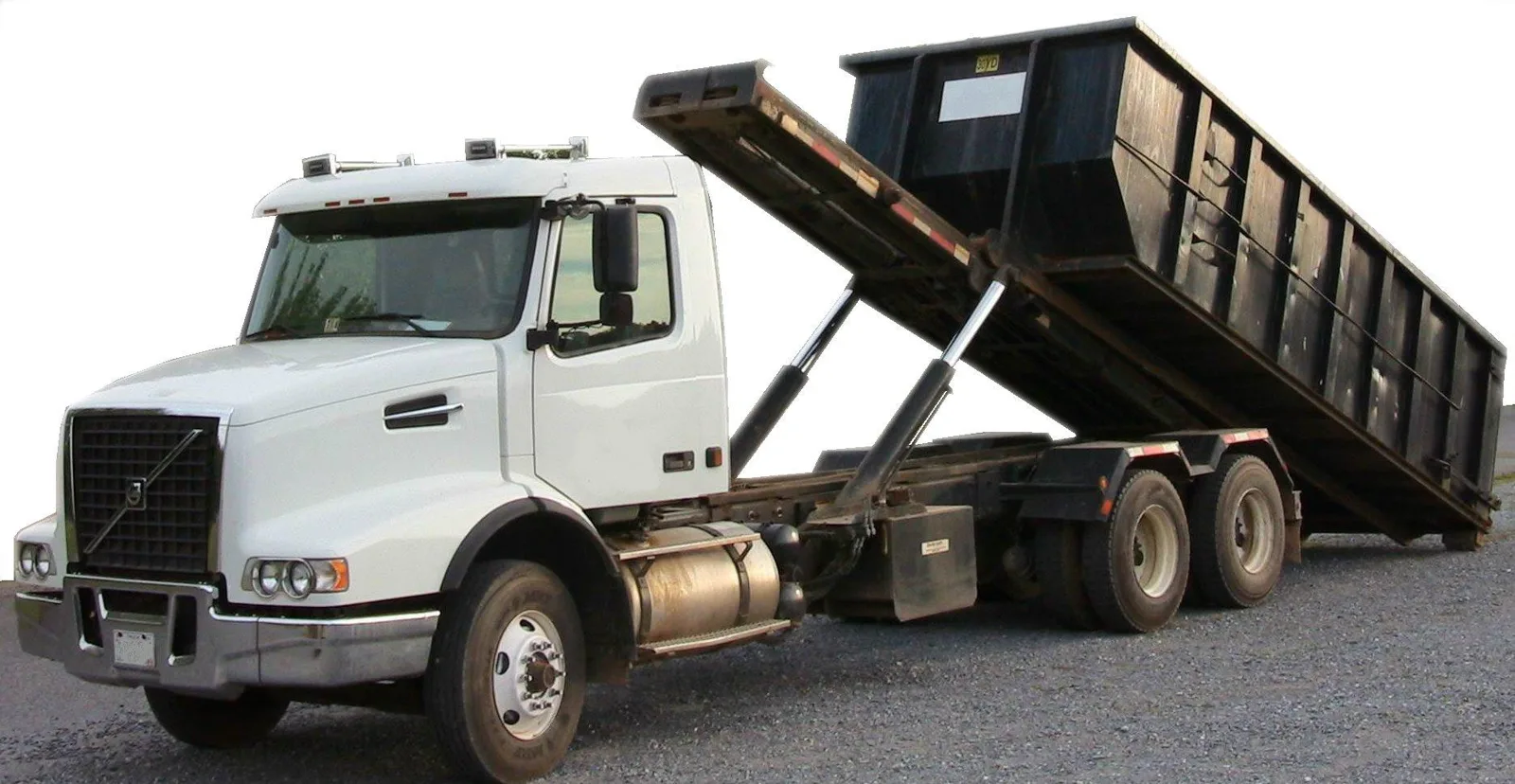
At about 14 ft 9 in, a 10 is roughly 8 ft shorter than a 20. That helps on short driveways and narrow lots, but the truck still needs about 8½ ft of clear width and a straight run to back in.15
Heavy loads need firm ground
A level-full 10 of broken slab weighs about 11.9 tons, roughly twice a level-full 40 of household trash. Set it on pavement or firm, dry ground, and keep it at least 10 ft from overhead power lines.647
Sort before the drop
Garage and basement cleanouts turn up the things that can't go in: paint and solvents, batteries, tires and other household hazardous waste. Pull them out first, and ask about a street permit if the box can't go on your property.8

Next sizes up
The 10 against the 15 and 20.
| Size | Length | Width | Height | Volume | Tons included |
|---|---|---|---|---|---|
| 10 yard (this page) | about 14 ft 9 in | about 8 ft | about 4 ft | 270 cu ft | 1 to 3 |
| 15 yard | 14′9″ to 16′9″ | about 8 ft | 4′7″ to 4′10″ | 405 cu ft | 2 to 3 |
| 20 yard | 22′9″ to 23′ | 7′9″ to 8′ | 4′3″ to 4′7″ | 540 cu ft | 2 to 4 |
The 10 and 15 share a short footprint. The 20 adds about 8 ft of length and about twice the volume.13
Market availability
Not every market stocks 10s
399 providers in our network delivered 10-yard containers from October 2024 through October 2026, against 886 for 20s. Some markets don't stock a 10. Where that's the case, we'll quote a 20 with the same tons included, so you pay for the weight you need and not extra space.3 Check your state's coverage page.
Your quote
What a 10-yard quote spells out.
Most 10-yard quotes in our provider network are a flat rate per haul, with a set number of days and tons. Across our 10-yard orders, the median rental period was 10 days. Seven days was the most common, then 14 and 10.3
- Say whether it’s general debris or concrete and dirt. They’re quoted on different tons.
- On a heavy load, ask where the fill line is before you start.
- If the market has no 10, we’ll quote a 20 at the tons you need.
Want to see a sample invoice line by line? It's in how dumpster rental is billed.
We don't post prices for 10s. The provider, the market and the material set the rate, the tons and the days, and your written quote lists each one.
Sources
- Container manufacturer spec sheets: Wastequip rectangular roll-off brochure; Custom Container Solutions standard rectangular roll-off; Rudco roll-off containers; American Made Dumpsters rectangular roll-off product sheet. Accessed Oct 27, 2026.
- Ford, 2026 F-150 specifications: cargo volume 52.8 cu ft (5.5 ft bed), 62.3 cu ft (6.5 ft bed), 77.4 cu ft (8 ft bed).
- Detritus provider network order records, 10-, 15-, 20-, 30- and 40-yard standard containers and 10-yard heavy-load containers delivered Oct 26, 2024 to Oct 26, 2026, canceled orders excluded.
- US EPA, Volume-to-Weight Conversion Factors, April 2016.
- Roll-off hoist spec sheets: JWR AFCD-OR-22/24 and Galbreath AF series (raised height above frame 173 to 191 in, frame 45 in above ground, tire width 98 to 101.5 in, hoist length 281.5 to 305.5 in).
- FHWA, earthwork density and swell table (Exhibit 5-1A): broken concrete 3,960 lb per in-place cu yd, 2,370 lb loose, 67% swell; asphalt 3,240 lb in place, 50% swell; topsoil 2,430 lb in place, 56% swell.
- eCFR: 23 CFR 658.17 (vehicle weight); 29 CFR 1926.600(a)(6) (equipment near power lines); 40 CFR 82.155 (refrigerant recovery before appliance disposal).
- US EPA, Household Hazardous Waste.
Book a 10.
Tell us the ZIP, the job and whether it's concrete or general debris. We'll come back with the tons, the days and the fill line.