Your customer app
Every unit is a record you can pull up.
Active sites, upcoming deliveries, open invoices, and the service history behind every location. Plus the name and direct line of the person who owns your account.
How it works
The same four stages apply to every order, from a single restroom to a 573-placement program. Existing provider records show who covers the county before sourcing even begins.
Updated October 9, 2026.
Intake
Orders placed by email, our customer app, or API reach the same intake queue and are priced against local supply. Your team can keep its current process.
Send a site list, a drawing set, or a rough duration to your account manager. Most scopes come back the same day.
Request a new service against an existing site, or open a fresh location, without waiting on anyone.
Push orders from your procurement, field service, or facilities platform by API, file, or email. Same queue, same pricing.
Order workflow
The site address is matched against coverage radius, rate card, insurance status, and service history for 7,700+ providers we have already paid. An unfamiliar county can therefore be matched from existing records. On our largest single site the match resolved to eleven providers working one program.
Pricing comes from what units actually cost in that market, drawn from our own paid transactions at the city level across 5,908 cities. Where there is no local history, we price from the nearest markets and the rate cards of providers whose radius reaches the site. Rates are based on paid history.
Every unit becomes a tracked record: delivery, service cycle, swap, tonnage, removal. Service frequency runs on a schedule rather than a memory, and exceptions surface before you call. Unit counts scale with crew count instead of a fixed contract quantity.
Consolidated invoicing with your account rates applied automatically, split by entity, region, or cost center if you need it. Insurance certificates and vendor documentation are managed centrally. Your AP team sees one bill and ours sees the detail.
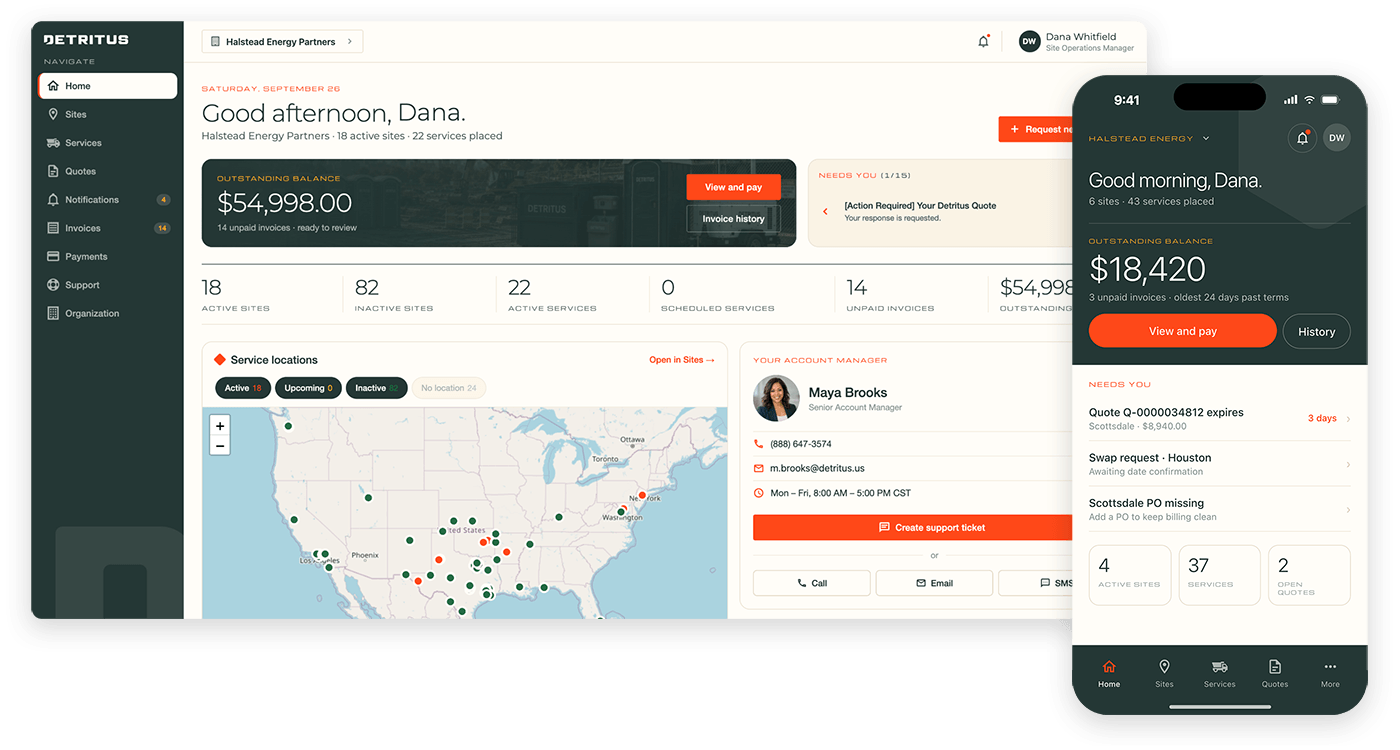
Your customer app
Active sites, upcoming deliveries, open invoices, and the service history behind every location. Plus the name and direct line of the person who owns your account.
When it goes wrong
A missed pump or pickup shows up as an open exception in our system, not as a call from your superintendent. One named person owns it through resolution. The provider record carries the miss, which is what keeps the network honest over time.
Site list, services, durations. Coverage and pricing come back, usually same day.
Account rates, billing structure, insurance requirements, and customer app access.
Units on site. Service schedules start. Your account manager is named and reachable.
Add sites, states, or services on the same agreement. No new sourcing cycle.
Common questions
Unfamiliar with a term? See the site services glossary.
From the nearest markets and from rate cards already on file for providers whose coverage radius reaches the site. Most sites price against real local supply rather than a national average.
Email, our customer app, or straight from your own system. Every channel lands in the same queue and returns a quote.
It surfaces as an open exception before your superintendent calls. One named person owns it through resolution, and the provider's record carries it.
A first order can be quoted same day in most markets. A multi-site program usually moves from scope to first delivery in one to three weeks.
Request coverage and pricing
A site list, a drawing set, or a rough duration. We come back with coverage, pricing, and a service schedule you can hand to procurement.