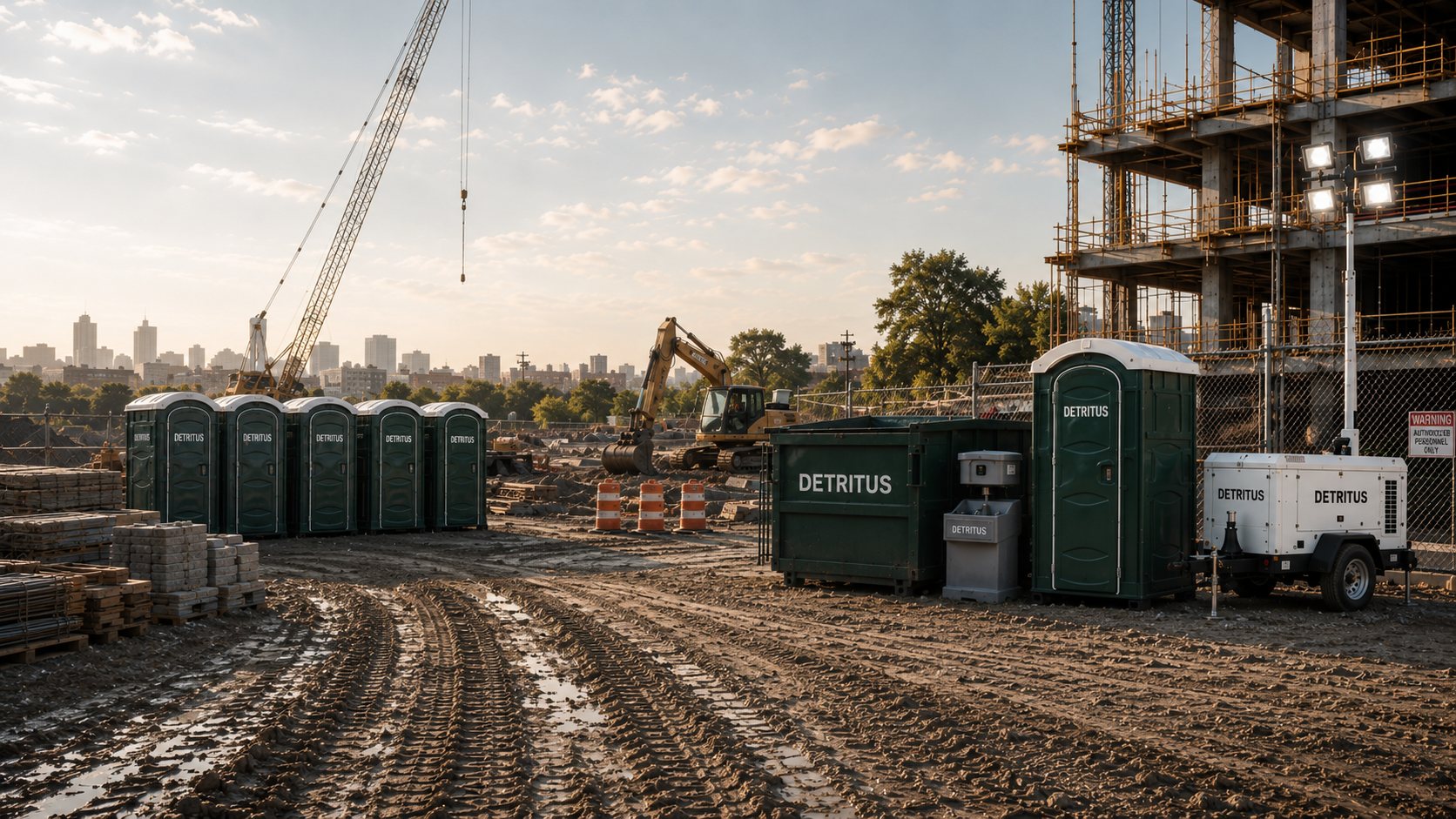
Site services · Sourced through our provider network
Temporary power for job sites and events.
A temporary service from the utility, or a generator sized to what you’ll actually run. We source it, schedule the fuel and send one bill.
Everything that runs at once
Plus the biggest motor kick
GFCI on 120 volt outlets
Two ways in
A temporary service from the utility, or a generator.
| Utility temporary service | Generator | |
|---|---|---|
| How it works | An electrician sets a pole and panel; the utility sets a meter after inspection. | Delivered, placed outside and refueled on a schedule. |
| Lead time | At least 10 business days when line construction is needed. | As fast as delivery. |
| What you handle | The permit, the pole (at least 20 ft, set 4 ft in the ground) and the inspection. | Placement, clearance and the fuel schedule. |
| How long | An estimated year or less. | Days to months. |
| Good fit | Long builds with a nearby line. | Short jobs, events and sites without a line. |
Generator sizing
How big a generator do you need?
Enter how many of each will run at the same time. The biggest motor sets the peak.
Starting watts
Pick a generator whose running rating covers the first number and whose starting or surge rating covers the big one. The wattages are approximate.
Quote this generator →Running and starting
Motors need a kick to start, so the biggest one sets the peak.
| Load | Running watts | Extra starting watts |
|---|---|---|
| Window AC, 12,000 BTU | 3,250 | 3,950 |
| Coffee maker | 1,500 | 0 |
| Computer and monitor | 800 | 0 |
| Two halogen work lights | 2,000 | 0 |
| Circular saw, 7 1/4 in | 1,400 | 2,300 |
| Total | 8,950 | 3,950, the largest one |
Protection
On a construction site, the 120 volt outlets need GFCI.
29 CFR 1926.404 and 1926.405(a)(2).
Feeders
Temporary feeders come from a distribution center and are protected from damage.
Branch circuits
Each starts at a panel or receptacle with its own overcurrent protection.
Receptacles
120 volt, 15 and 20 amp receptacles need GFCI unless they’re part of permanent wiring.
Disconnects
A way to cut power to every circuit.
When the job’s done
Temporary wiring comes out when the work it served is finished.
Placement
Outside, in the open, and never wired straight into a building.
Never indoors
Not in a garage, shed or crawl space, even with a door open.
Room to breathe
3 to 4 feet of clearance on every side.
A transfer switch or nothing
Backfeed can energize lines far from the site.
Cool before refueling
Shut it down and let it cool.
Keep it dry
Under a canopy, on a firm, dry surface.
Fuel
The refill schedule matters as much as the size.
A generator that runs dry stops the site. We schedule fuel with the rental.
Fuel deliveries since August 2024
Sites served
Container offices we looked at have a 125 amp interior panel, and some a 60 amp exterior disconnect. See office trailer rental.
Next step
Get a temporary power quote.
Send what you’ll run, the dates and the address.
Questions
Questions about temporary power.
How do I size a generator for a job site?
Add the running watts of everything that runs at the same time, then add the largest extra starting load among them. The generator's running rating has to cover the first total and its starting rating the second.
What's the difference between running watts and starting watts?
Running watts are what a load draws once it's going. Starting watts include the short extra pull a motor needs to spin up. A light or coffee maker has none; an air conditioner or saw can need more than double.
Does OSHA require GFCI on generators?
On construction sites, 120 volt, 15 and 20 amp receptacles not part of permanent wiring need GFCI under 29 CFR 1926.404(b)(1)(ii). Two-wire generators of 5 kW or less with insulated conductors are the exception.
How long does it take to get temporary power from the utility?
It depends on the permit, the inspection and the utility. One large utility says line construction, when it's needed, takes at least 10 business days, and it won't set the meter until the inspector reports back.
Can I plug a generator into my site office's panel?
Only through a transfer switch a qualified electrician installed. OSHA warns that a direct connection can backfeed and energize wiring for great distances.
Read next
Sources
- Duke Energy, Requirements for Electric Service and Meter Installations, April 2026: establishing temporary construction service; the electrician sets the temporary meter base, the company holds the application for inspection, line construction when needed requires a minimum of 10 business days, and the city or county inspects and notifies the company before the meter is installed. Checked October 29, 2026. duke-energy.com
- City of Alameda, Temporary Electric Service Requirements: temporary service poles for installations where service is estimated at one year or less, furnished and installed by the customer, wooden, 20 feet minimum and set four feet in ground; city permits and inspection required before service is connected. Checked October 29, 2026. alamedaca.gov
- Generac, GP Series 3600 to 8000 Watt Portable Generators brochure (GP6500E), How Much Power Do You Need: add running watts of devices used at the same time, then the one highest starting watts; table of running and additional starting watts (window AC 12,000 BTU 3,250 and 3,950; refrigerator 700 and 2,200; microwave 1,000; coffee maker 1,500; computer with 17 in monitor 800; quartz halogen work light 1,000; air compressor 1/2 HP 1,000 and 2,000; circular saw 7 1/4 in 1,400 and 2,300; table saw 10 in 2,000 and 2,000; reciprocating saw 960; hand drill 1/2 in 600 and 900; belt sander 3 in 1,200 and 2,400; airless paint sprayer 1/3 HP 600 and 1,200; sump pump 1/2 HP 1,050 and 2,150); watts approximate, assumes intermittent starting. Checked October 29, 2026. generac.com
- 29 CFR 1926.404(b)(1)(ii), ground-fault circuit interrupters on construction sites, and 1926.404(f)(3)(i), portable generators as grounding electrode. Checked October 29, 2026. ecfr.gov
- 29 CFR 1926.405(a)(2), temporary wiring: removal on completion, feeders, branch circuits, receptacles and disconnects. Checked October 29, 2026. ecfr.gov
- OSHA Fact Sheet 3286, Using Portable Generators Safely: never indoors or in enclosed spaces, 3 to 4 feet of clear space on all sides and above, no direct connection to a structure without a transfer switch installed by a qualified electrician, shut down and cool before refueling, keep dry. Checked October 29, 2026. osha.gov