Wheel wash and track-out control

Mud that leaves your site on tires ends up on the street and in the storm drain, and stormwater permits make it your problem. We source wheel wash stations, rumble plates and stabilized entrances from local providers in the markets we serve, and schedule them with the rest of your site services. Availability varies by market.

  • ExitDesignated and stabilized
  • WashTires before the street
  • SweepWhatever still gets out
  • Service
  • Updated November 4, 2026
  • Sources: U.S. EPA
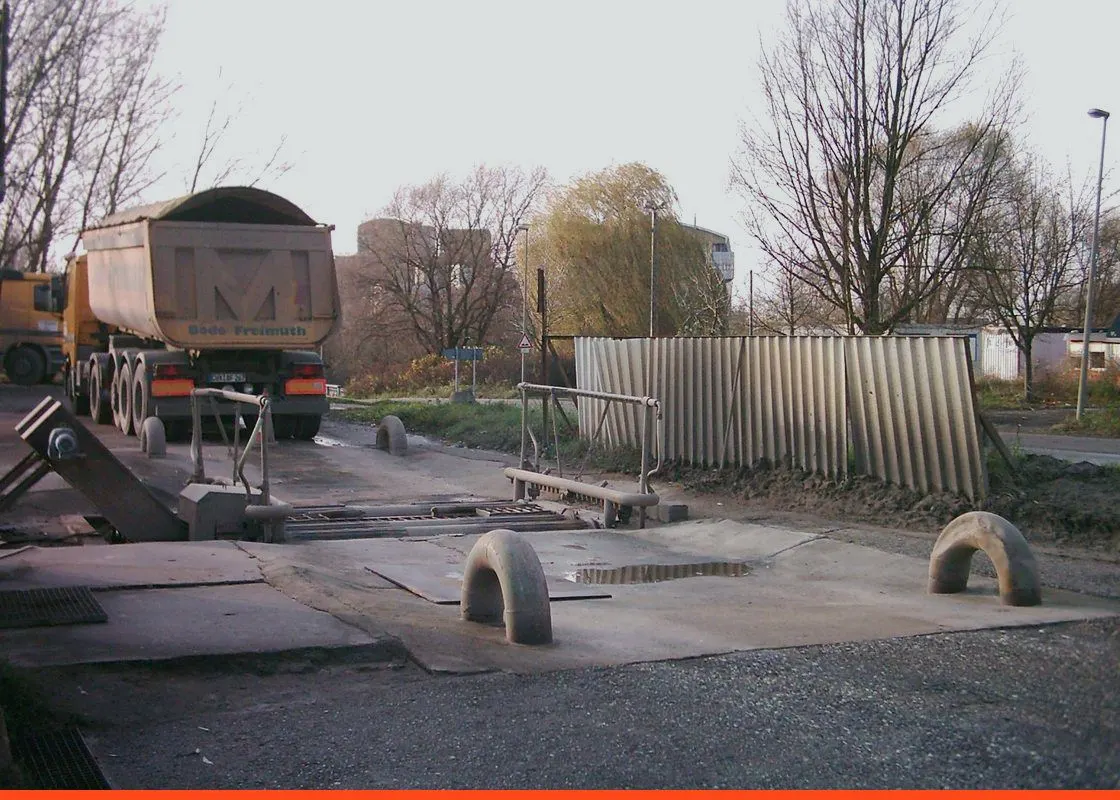
A dump truck leaving a site through a drive-through tire wash with spray bars and a grate
Photo: GeorgHH, public domain.

What it is

Layers between your site and the street

Track-out control is a set of practices at the site exit. Most sites start with a stabilized entrance and add more when mud still gets out.

Street sweeping is the backstop for whatever still reaches the road. Ask us about it for your market.

Common track-out controls

  1. Stabilized entranceA pad of aggregate stone over geotextile fabric at the exit, which knocks mud off tires and keeps trucks out of the soil.
  2. Rumble platesSteel plates or grates that shake mud loose as tires roll over them. The permit calls them rumble strips and rattle plates.
  3. Wheel washA station that sprays the tires as trucks pass, with the wash water collected rather than sent to the street.
  4. SweepingSweeping, shoveling or vacuuming the sediment that still gets onto paved roads and sidewalks.

When a job needs it

Sites that need more than a gravel drive

Track-out control matters most where soil is exposed and trucks leave onto pavement.

  1. 01

    Earthwork and grading

    Exposed soil and wet weather put mud on every tire that crosses the site.

  2. 02

    Exits onto paved roads

    EPA's construction permit requires stabilization at every exit onto a paved road.

  3. 03

    Haul-heavy phases

    Excavation, demolition and import or export of fill, when trucks come and go all day.

  4. 04

    Complaints or a notice

    When the city or an inspector has already flagged mud on the street.

The rules

What the construction stormwater permit says

EPA's 2022 Construction General Permit applies where EPA is the permitting authority, to sites that disturb one acre or more or are part of a larger plan that will. Most states run their own permits with similar rules, so check yours.

CGP Part 2.2.4

Use designated, stabilized exits

Restrict vehicles to properly designated exit points, and stabilize every exit onto a paved road. The permit gives aggregate stone over geotextile or non-woven filter fabric, and turf mats, as examples.1

CGP Part 2.2.4

Add controls if mud still gets out

Add track-out controls as needed so sediment comes off before vehicles leave. The permit lists wheel washing, rumble strips and rattle plates as examples.1

CGP Part 2.2.4

Clean the street the same day

Remove sediment tracked onto paved roads, sidewalks or other paved areas by the end of the same business day, or the next business day if it happens on a non-business day, by sweeping, shoveling or vacuuming. Hosing or sweeping it into a drain, inlet or water is prohibited.1

CGP Part 2.3.2

Manage the wash water

Wheel wash water falls under the vehicle washing rules: minimize pollutants in the discharge, for example by sending it to a sediment basin or trap or through a filter, and keep soaps, solvents and detergents out of it.1
Your stormwater plan should show each exit and the controls at it. See SWPPP site services and erosion control.

Mud on the street?

Tell us the exits, the trucks and the soil. We source the control that fits each exit.

The options

Which control for which exit

Controls stack. A stone pad is the usual start, and plates or a wash station go on top where mud still gets out.

ControlWhat it doesUsually fits
Stabilized entranceA stone pad over fabric that knocks mud off and keeps tires out of the soilMost sites, as the first control at each exit onto pavement
Rumble platesSteel grates that shake mud loose from the tiresExits where the stone pad alone is not enough, or where room is short
Wheel wash stationSprays the tires, with the water collected and managedHeavy clay, wet seasons, long haul phases or strict local rules
Street sweepingRemoves sediment that still reaches the roadEvery site, as the backstop when track-out happens

A wheel wash needs water. If the exit has no supply, water delivery can fill it.

How it works with Detritus

One request for every exit

You get one point of contact. A local provider supplies and maintains the controls.

  1. You tell us the exits

    The address, the exits trucks use, the traffic and the soil.

  2. We source a local provider

    The right control for each exit, quoted with your other site services.

  3. Delivery and setup

    The provider sets the plates or the wash station, or builds the stone pad.

  4. Upkeep

    Pads get topped up and plates and wash pits get cleaned as sediment builds. Call us when it needs service.

  5. Removal

    The equipment comes out when the site no longer needs it.

For a quote

What to tell us

Tell us about each exit. The answers decide whether a stone pad is enough or a wash station is worth it.

  • The site address and how many exits trucks use
  • What each exit opens onto: a paved road, a sidewalk or a private drive
  • How many trucks a day, and the haul phases
  • The soil and the season
  • Water and power at the exit, for a wash station
  • How long you need the controls
  • Your stormwater plan or permit conditions, if you have them

Common questions

Track-out questions

What is track-out?

Mud, soil and sediment carried off a construction site on vehicle tires onto paved roads, sidewalks and other paved areas.

Does the stormwater permit require a wheel wash?

Not always. EPA's construction permit requires stabilized exits onto paved roads and more controls as needed, and lists wheel washing, rumble strips and rattle plates as examples. Your state permit or local rules may ask for more.

How fast do I have to clean up track-out?

Under EPA's construction permit, by the end of the same business day, or by the end of the next business day if it happens on a non-business day.

Can I hose mud off the street?

Not into a drain. The permit prohibits hosing or sweeping tracked-out sediment into any site drainage feature, storm drain inlet or receiving water.

What happens to wheel wash water?

It has to be managed so pollutants are minimized, for example by sending it to a sediment basin or trap or through a filter, with no soaps, solvents or detergents in the discharge.

How do I get a quote?

Call sales at (888) 588-2607 or request a quote with the address, the exits and how long you need the controls.

Track-out control on one agreement

Local providers do the work. We source them, schedule them with your other site services and send one bill.

Read next

Sources

  1. U.S. EPA, 2022 Construction General Permit, Parts 1.1.2, 1.1.3, 2.2.4 and 2.3.2. Applies where EPA is the permitting authority. Checked November 4, 2026. epa.gov