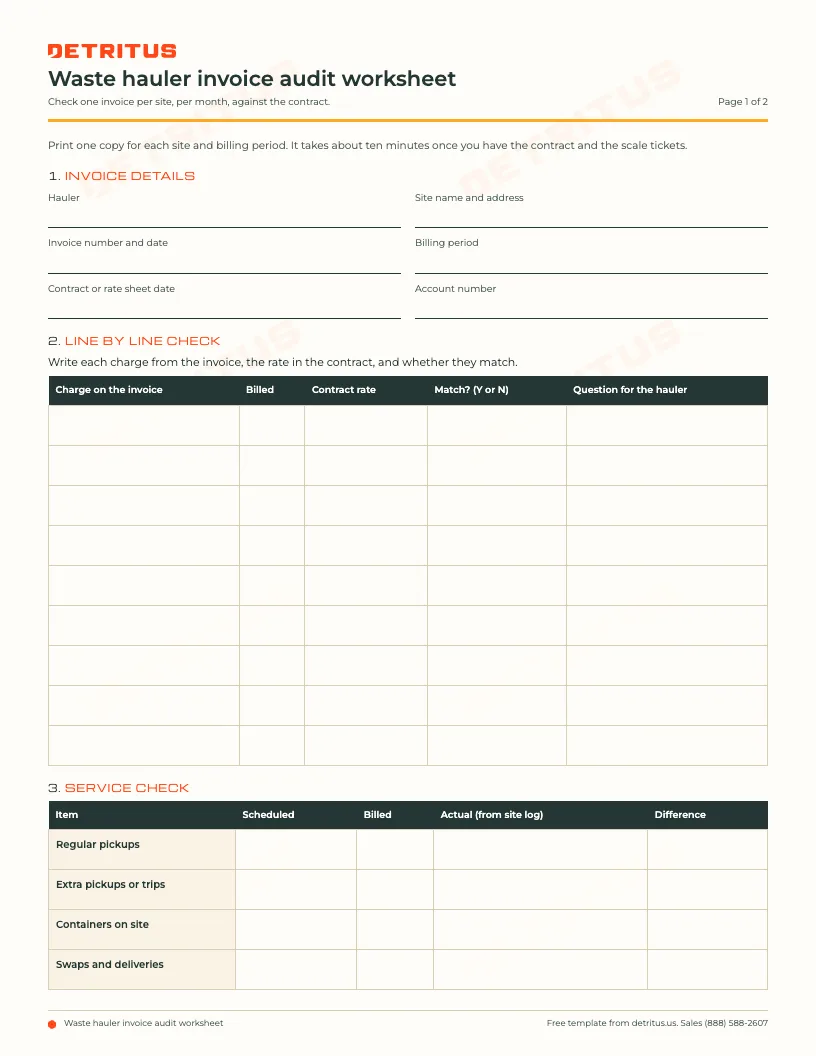
Page 1: details, line check and service check
Invoice block, a table to match each charge to the contract, and a check of pickups scheduled, billed and made.
UseFill in with the invoice open
Waste invoices drift. A pickup you never had shows up, a fee appears that the contract does not list, a weight cannot be matched to a ticket, or a rate rises without notice. An audit is a ten minute check per site, per month, of the invoice against the contract and the scale tickets. Our free two page worksheet walks you through it.
The check
Do these on every invoice before you approve it. If you manage many sites, do them on the same day each month so the pattern shows.
| Check | What to compare | What a problem looks like |
|---|---|---|
| Charges against the contract | Each line on the invoice against the rate sheet or contract | A fee the contract does not list, or a rate that differs from the sheet |
| Service billed against service made | Pickups, swaps and extra trips on the invoice against your site log | A pickup billed that your site did not receive, or a trip charge with no record of a blocked box |
| Weights against tickets | Scale tickets for each haul against the weight on the invoice | A billed weight with no ticket, or ticket weights that do not add up |
| Fuel surcharge | The method in the contract against the published price for the week named | A surcharge percent that does not match the contract table for that price |
| Rate changes | Today's rate against last month's and the cap in the contract | An increase above the cap, or one that started without the notice the contract requires |
We send one invoice for all of your sites and we deal with the haulers when a charge is wrong. Tell us how many sites you have and what you pay for today.
Weights and fuel
If you pay by weight, every billed haul should have a scale ticket, or a weight you can get on request. Match the ticket number, the weight and the material, and check that the disposal facility is the one named in your contract. Commercial scales are covered by NIST Handbook 44, which sets specifications and tolerances for weighing devices, and state weights and measures offices commonly use it to inspect scales.1 If a weight looks off, ask for the ticket first and the scale's inspection record second.
If your contract ties the fuel surcharge to a diesel price index, look up that week's published price and apply the formula in the contract. EIA publishes a weekly retail on-highway diesel price series that shippers and truckers often use for this.2 EIA does not set or regulate surcharge methods, so the formula that counts is the one in your contract. If the contract has no method at all, that is the first thing to fix at renewal.
Fixing it
Many billing mistakes are corrected with a call and the right paper. These four steps keep the dispute short.
Record the charge, the invoice number, the contract line it conflicts with and the amount. The worksheet has a table for it.
Attach the contract page, the scale ticket or the site log entry. Ask for a credit or a corrected invoice, and give a date.
One error is a mistake. The same error across several sites or months is a billing setup problem, and it should be fixed at the account level.
Bring the log to your next business review or renewal. Add the audit right and the reporting you need to the next contract.
The worksheet
Two letter size pages. The PDF has fields you can type into, and the Word version opens in any editor. Use one copy per site, per billing period.
Invoice block, a table to match each charge to the contract, and a check of pickups scheduled, billed and made.
UseFill in with the invoice open
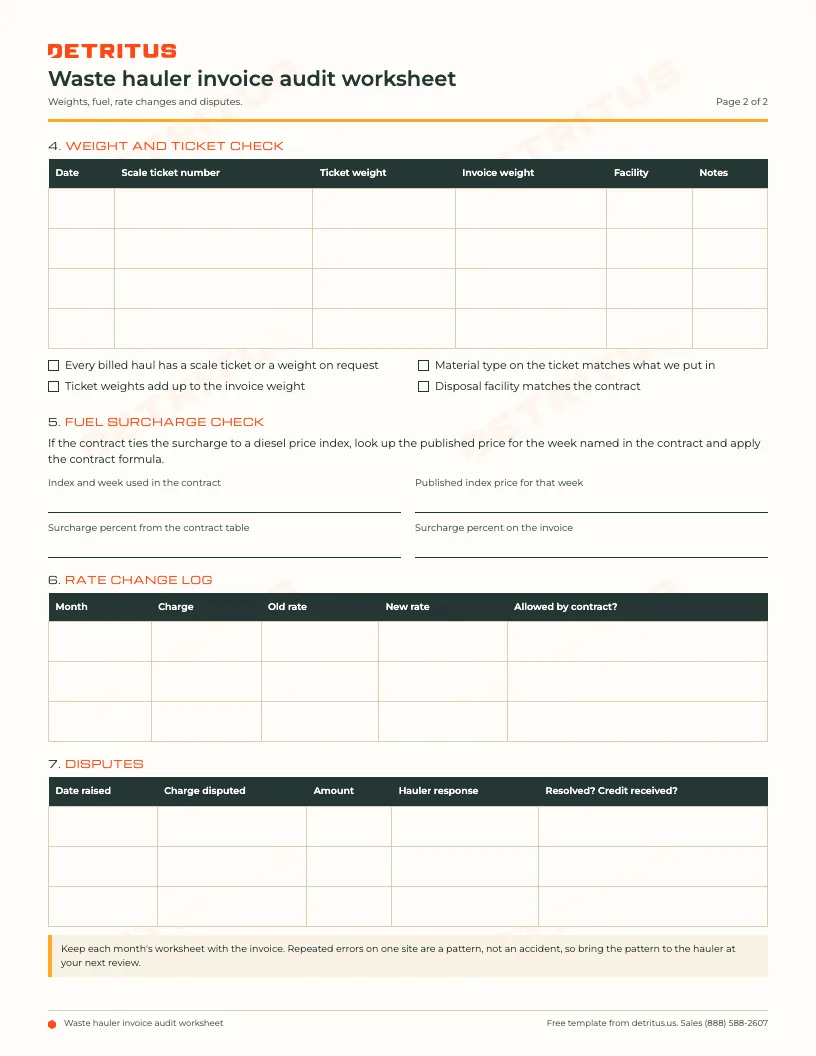
A ticket by ticket weight table, the fuel surcharge check, a rate change log and a dispute log.
UseKeep with the invoice file
Common questions
Match each charge to your contract, compare pickups billed with pickups made, match scale tickets to billed weights, test the fuel surcharge against the contract method and check rate changes against the contract cap. Do it for every site every month.
Base service or rental, haul or pull, disposal, weight overage, fuel, environmental or regulatory fees, delivery, extra pickups and trip charges. Any of them can be legitimate. The question is whether your contract lists it.
Monthly for large or multi-site accounts, and at least quarterly for a single site. Do the first audit on the last three invoices to find out what is already wrong.
Yes. If you pay by weight, ask for the ticket with each haul or on request. Put that in the contract if it is not there.
Add one at renewal, along with monthly reporting by site and a cap on rate increases. Until then, ask for the records anyway. Ask in writing and keep the reply.
No. An audit finds what is wrong now. If errors keep recurring, the next step is a better contract, which our RFP template covers.
Local providers do the work; we hold the contract, own the problems, and send one bill. If a charge is wrong, we handle it with the hauler.
Read next
Sources