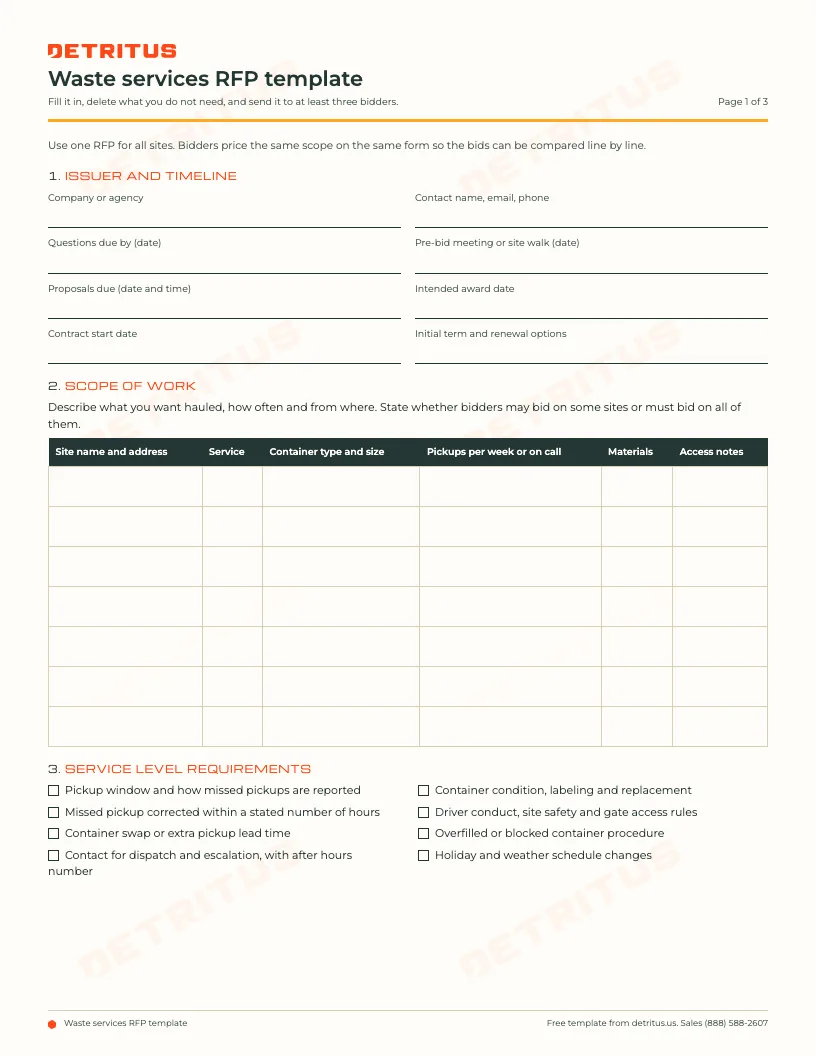
Page 1: issuer, scope and service levels
Timeline block, a site table for scope and a checklist of service levels to require.
UseEdit once, send to every bidder
A waste services RFP asks haulers to bid on the same scope, with the same pricing form, so you can compare bids line by line instead of guessing what is in each number. Our free three page PDF gives you the sections, the pricing lines most bids leave out, the contract terms worth requiring and a scoring sheet. Fill it in, send it to at least three bidders and score the answers before you look at price.
The outline
Most waste RFPs fail in the same place: the scope is vague, so every bidder prices something different. The sections below are the ones we would fill in first.
| Section | What to put there | Why it matters |
|---|---|---|
| Issuer and timeline | Contact, question deadline, site walk date, proposal deadline, award date, start date | Bidders who miss the deadline for questions guess, and guesses show up as add-on charges later |
| Scope of work | Each site, service, container type and size, pickups per week, materials and access notes | One scope means one comparison. Say whether bidders can bid on part of the list |
| Service levels | Pickup window, missed pickup response time, swap lead time, escalation contact, container condition | A low price with no service standard is a price for a service you may not get |
| Pricing form | Every charge that can appear on an invoice, each with its basis and rate | Lets you add up the same lines for every bidder and see what is left out |
| Contract terms | Rate lock and cap, fuel method, insurance, termination, audit right, renewal, invoicing | These decide what the price does in year two |
| Reporting and diversion | Monthly report by site, weights, diversion goals, annual review | You can only manage what shows up in a report |
| Scoring | Pass or fail minimums, weighted criteria, who scores | Setting this before bids arrive keeps the decision about the work, not the last phone call |
Give us your site list and service levels. We will line up local providers in every market and keep it on one agreement, so you do not run a separate RFP in each city.
The pricing form
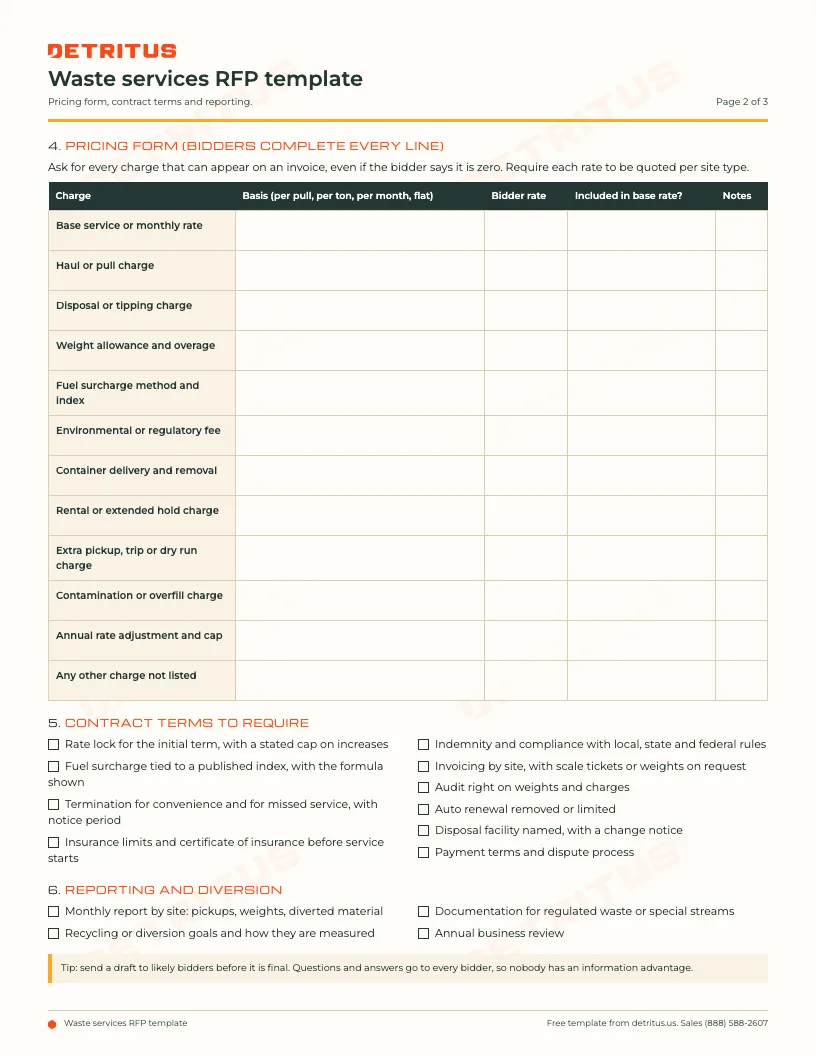
The pricing form is the part of the RFP that saves the most money, because it forces each bidder to say what they charge for. A bidder who leaves the fuel line blank has not quoted zero. Ask for the base rate, the haul or pull, disposal, the weight allowance and what happens over it, the fuel surcharge method, any environmental or regulatory fee, delivery and removal, rental or hold charges, extra pickups and dry runs, contamination or overfill charges and the annual rate adjustment.
Ask how the fuel surcharge is set and which published price it follows. Each hauler sets its own method, and EIA does not calculate or regulate surcharges.2 If a bidder ties the charge to a weekly published diesel price, you can check it later with the same series. If the method is a table the bidder controls, you want that table in the contract.
Evaluating bids
EPA gives local governments examples of procurement practice that work for any buyer: set pass or fail minimums up front, such as years of experience with the service you want, and consider a best and final round after the first one.1 The weights and the scoring sheet are our suggestion.
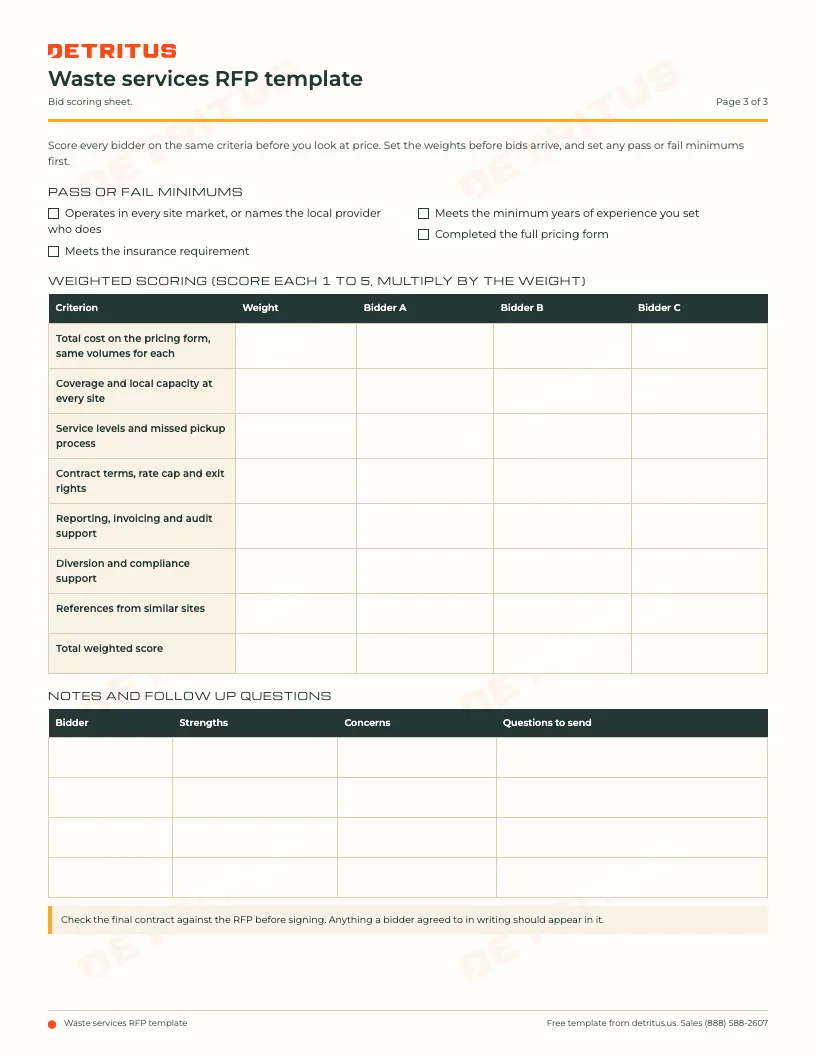
Decide what a bidder must have to be scored at all: coverage at every site, insurance, minimum years of experience, a completed pricing form. Anyone who misses one is out before you compare anything else.
Choose how much cost, coverage, service levels, contract terms, reporting and references each count for. Do it before bids arrive so nobody rewrites the weights to favor a bid.
Have two people score everything except cost on a 1 to 5 scale. Then add the cost score from the pricing form, using the same volumes for every bidder.
If the top two bids are close, ask both for a final offer against a clarified scope. Then check the contract against the RFP before you sign.
The template
Three letter size pages. The PDF has fields you can type into, and the Word version opens in any editor. Use the preview to see the layout first.
Timeline block, a site table for scope and a checklist of service levels to require.
UseEdit once, send to every bidder
Every charge on one form, plus the contract terms worth requiring and the reporting you want.
UseBidders complete every line
Pass or fail minimums, weighted criteria for three bidders and a notes table.
UseFill in before bids arrive
Common questions
A request for proposals is a document that asks haulers to bid on the same scope of waste and recycling service. It sets the sites, the services, the service levels and the pricing form, so the bids can be compared line by line.
The issuer and timeline, a site by site scope, service level requirements, a pricing form that covers every possible charge, the contract terms you require, reporting and diversion needs and how you will score the bids.
At least three. For many sites in many markets, include national haulers and at least one provider network, since no single local hauler covers every market.
It should count, but not alone. A low base rate can come with a weak missed pickup process, no rate cap and a long list of add-on fees. Set the weights before bids arrive.
If you are a public agency, your purchasing office sets binding rules. For a private buyer, have counsel read the contract terms and the final agreement. The template is a starting point, not legal advice.
We can take the scope you already have and source local providers for every site on one agreement. Call sales at (888) 588-2607 and tell us the sites and the services.
Local providers do the work; we hold the contract, own the problems, and send one bill. If a pickup gets missed, we contact the hauler the same business day.
Read next